Your Nonprofit Is Killing Its Own Future—and Calling It Continuity
How a mission-driven organization protects its inner circle, blocks succession, and calls the result “continuity.”
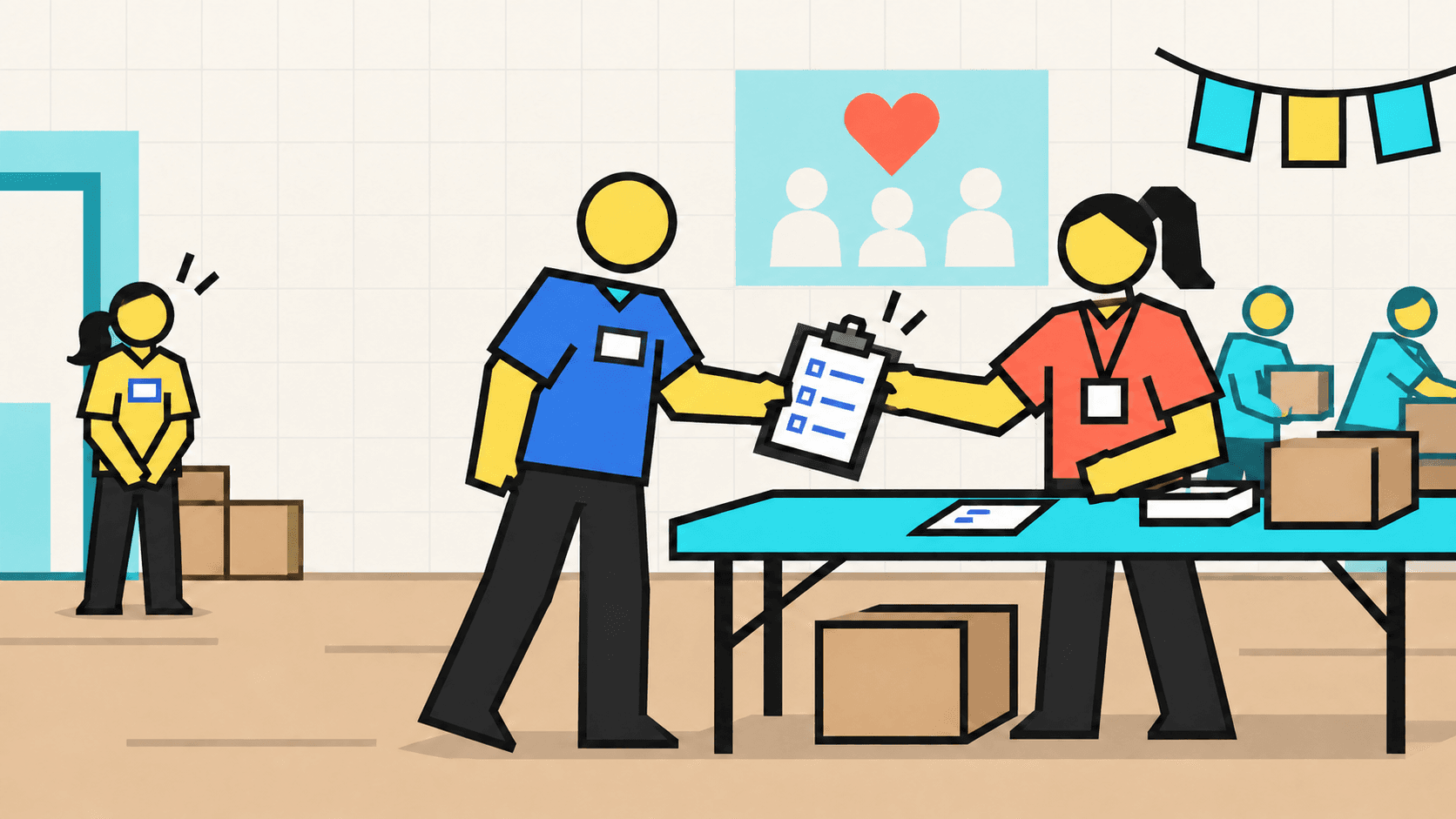
By 8:12 on Saturday morning, Mara had answered three texts, found two missing folding tables, and stopped one volunteer from walking out.
Mara was the volunteer coordinator.
That was her title.
It was not quite her job.
Her job was to send the emails, fill the volunteer slots, print the badges, and make sure the board could say the event ran smoothly.
The person who actually decided how the event ran was Frank.
Frank had no official title. He did not need one.
He had been with the organization for twenty years. He knew every donor by first name, every storage closet, and every story about the time a new process “almost ruined everything.”
When Frank said, “We don’t do it that way,” the room changed direction.
At 8:15, a new volunteer named Alana walked through the door. She had signed up online. The website said:
No experience needed. Everyone is welcome.
Mara smiled, handed her a badge, and said, “I’m glad you’re here. Can you help me run check-in?”
Before Alana could answer, Frank took the clipboard from Mara’s hand.
“She should start with setup,” he said. “Check-in has a flow.”
Mara looked at Alana.
Frank was already walking away.
Alana carried boxes. Frank corrected the way she stacked them. She asked where the signs went. He told her to “watch for now.” When she tried to help at check-in, he stepped in front of her and finished the work himself.
By 9:30, Alana was standing beside a wall, holding a roll of tape.
The event went well.
That was the problem.
No donor complained. No table collapsed. The board saw smiling faces and full rooms.
Mara saw a capable person kept useless.
On Monday, Alana sent a short email:
Thanks for having me. I don’t think this is the right fit for me.
At the next planning meeting, someone said, “We need more reliable volunteers.”
Frank nodded.
“New people never stick around.”
Mara pulled up the org chart and stared at the blank space beside his name.
But everyone knew who held the job.
The names in this story are made up. The pattern is not.
The front door is open. The room is not.
This is not a story about one rude volunteer.
It is a story about an organization with two chains of command.
There is the official one, where Mara is responsible for volunteers.
Then there is the real one, where Frank decides who gets trusted, who gets corrected, who gets information, and who gets to do anything important.
The nonprofit says everyone is welcome.
What it means is that everyone is welcome to help—as long as they do not become important enough to change anything.
A volunteer can be allowed to attend without being allowed to matter.
They can carry boxes. They can set up chairs. They can fill an empty shift. They can follow instructions from people who do not have a title but somehow have the final say.
They are not given the chance to lead, decide, build relationships, or make a mistake and remain trusted.
That is not a volunteer shortage.
It is a power problem.
This is not a training problem
Nonprofits often respond to this problem with the wrong tool.
They add an orientation. They rewrite the welcome email. They hold a team-building exercise. They ask longtime volunteers to be nicer. They recruit more people.
None of that matters if new people are never allowed to take over real work.
A person can be trained well enough to lead. They still need the chance to lead.
Instead, they get stuck in permanent shadowing.
They watch the experienced person for six months. Then a year. Then three years.
They are always “learning.”
They are never in charge.
That is not development. It is a leash.
Training prepares someone to lead. Authority gives them the chance to prove it.
Tribal knowledge is not the problem, either. Every organization has knowledge that newcomers need to learn. Healthy knowledge moves through the organization. People explain it, share it, and give others a chance to use it.
The problem starts when the people who know how things work also decide who is allowed to learn.
The issue is not that Frank knows more.
The issue is that Frank controls the path by which anyone else might know more.
The academic name is social closure
Researchers call part of this social closure.
The term sounds dry, but the idea is simple: people inside a group hold onto valuable opportunities and keep outsiders from getting them. Oxford Academic describes social closure as opportunity-hoarding by an in-group combined with exclusion of the out-group.
In a nonprofit, the closed group may be built around tenure, friendship, family ties, donor relationships, local status, or a shared history that nobody else can enter.
The group does not have to meet in secret. It may not even think of itself as a group.
It simply becomes the place where real decisions happen.
The same people get asked first. The same people get the important jobs. The same people decide who is “committed,” “trustworthy,” or “ready.”
The organization’s public mission is open to everyone.
Its internal power is not.
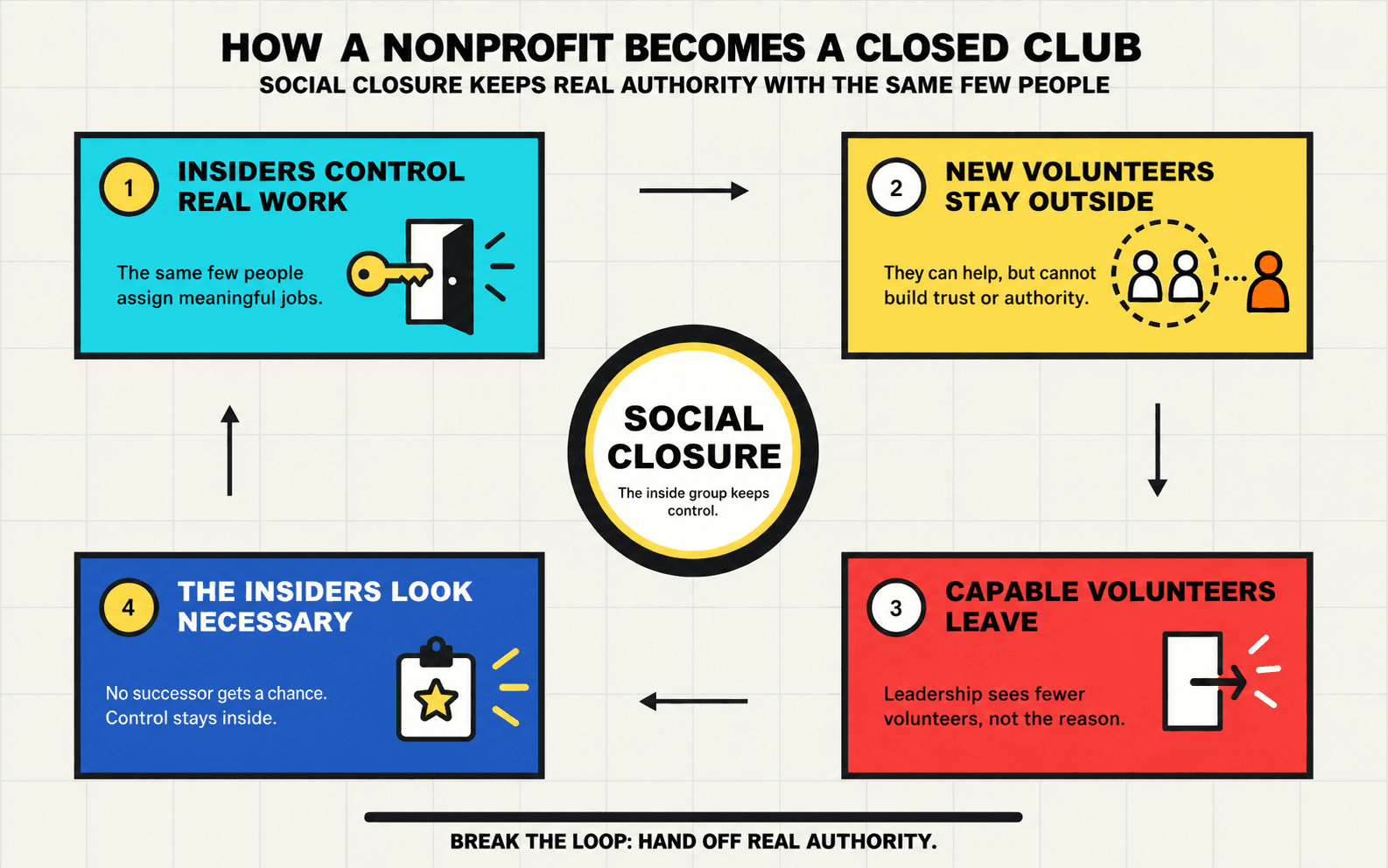
The loop is simple: control access, keep people peripheral, lose them, then use the loss as proof that the insiders are indispensable.
The four-step loop
1. Insiders control meaningful access
The same few people control the work that builds experience and standing.
They decide who leads the event, who gets introduced to the donor, who joins the planning call, and who is trusted with the part of the job that actually matters.
They may not block every newcomer on purpose. They may simply keep reaching for the people they already know.
But the result is the same.
The new person gets the work that needs hands, not the work that builds judgment.
2. Outsiders stay peripheral
Without meaningful responsibility, a newcomer cannot build the experience the organization says it requires.
They do not learn the full process. They do not meet the important people. They do not get to make small mistakes while the stakes are low.
Then someone says they lack experience.
Of course they do.
The organization gave them no way to get it.
The people inside the circle are trusted because they have experience. The people outside the circle are denied the experience that would make them trusted.
That is the trap.
3. People leave or go quiet
Some people leave after one event. Some stop volunteering. Some stay, but learn not to challenge anything.
The quiet volunteer may be perfectly capable. They may have a better idea. They may see exactly what is happening.
They also know that the person blocking them has friends, history, and influence.
So they keep their head down.
Silence does not mean the culture is healthy. It may mean the culture has taught people what speaking up costs.
That is not just a bad feeling. Research on former volunteers found that lack of autonomy and voice, alienation, cliques, and weak faith in leadership can drive people away. The people who leave are often telling you where the power problem is. Read the Voluntas study.
4. Incumbents look indispensable
Once enough people leave, leadership sees the same old faces doing all the important work.
The conclusion seems obvious:
“Nobody else is ready.”
“We cannot risk losing Frank.”
“The organization would fall apart without them.”
That may even be partly true. The organization has allowed too much knowledge, too many relationships, and too much authority to collect in one place.
So it protects the people who hold it.
The shortage the system created becomes the reason the system continues.
The club mentality test
You do not need a culture consultant to begin. Watch what happens when someone new tries to become useful.
Run four tests.
Can a newcomer become useful without becoming a friend?
If the only way to get a real assignment is to be personally chosen by an insider, the organization has a private entrance.
Can the formal lead actually lead?
If a person with no title can take work away from the person who owns it, the org chart is theater.
What happens to dissent?
If questions get called disrespectful, new ideas get buried under “we tried that,” and everyone learns to stay quiet, the club is protecting itself.
Does the place work when Frank stays home?
If one longtime volunteer’s absence stops decisions, relationships, or basic work, the organization has built a dependency—not a succession plan.
The question underneath all four tests is simple:
Who is allowed to become important here?
That question is better than “Does everyone feel welcome?” People inside the circle may honestly say yes. Look at access instead: who gets information, responsibility, a second chance, and the right to say no?
Why firing Frank is not the whole answer
Frank may need to be removed.
If he is abusive, retaliates against people, blocks every successor, or refuses clear limits, removing him may be necessary.
But firing Frank alone does not repair the culture.
If the organization still rewards the loudest person, still keeps decisions in private conversations, still treats roles as personal property, and still lets formal leaders be overruled, someone else will fill the same space.
The organization will grow another Frank.
The “one bad apple spoils the bunch” story is comforting because it lets everyone else stay innocent. Blame one person. Write a policy. Move on.
But if removing one person restores the same power arrangement under a different name, that person was never the whole problem.
The problem is the orchard.
What Mara can do
Volunteer coordinators are often close enough to see the problem and too low in the structure to solve it alone.
Mara cannot fire Frank. She should not quietly stop scheduling him, either.
That may feel satisfying, but it turns her into another gatekeeper. It drives the fight underground, gives Frank a clean story about being pushed out, and leaves the real power structure untouched. If a formal leader decides Frank should be reassigned, that decision should be visible and backed by someone with actual authority.
Mara’s job is to make the hidden system impossible to dismiss as “just Frank being Frank.”
Give the work a name
When a new volunteer gets a real assignment, make the assignment public:
Alana is leading check-in today. Frank, please advise if she asks, but let her run the process.
That gives Alana a real role. It gives Frank a way to help without taking the role back. If he ignores the boundary, the problem is now visible.
Keep a record—but do not confuse it with a solution
A private log will not beat a protected insider. If it stays in Mara’s notebook, Frank’s friends can call it a grudge and keep doing exactly what they were doing.
The record has one job: make the pattern portable. Write down the date, the event, the formal assignment, who overruled it, what happened next, who saw it, and whether the volunteer returned. Do not write, “Frank is a jerk.” Write, “New lead assigned check-in at 8:15. Frank removed the clipboard at 8:17. New lead was moved to setup. Volunteer did not return.” Keep it secure and follow the organization’s rules about personal information.
Then send the pattern to someone who can make a binding decision—not just to the people who already protect Frank. Ask three questions in writing:
Who owns this role? Who may overrule that person? What will leadership do when the boundary is crossed?
If Mara’s supervisor is part of the same circle, she needs another formal route: the board chair, a governance committee, an ethics or safeguarding contact, or an outside body the nonprofit actually answers to. One person can be dismissed as having a grudge. Independent accounts from several affected volunteers are harder to wave away. Do not ask people to sign a group indictment. Ask each person to describe what happened in their own words.
If leadership receives clear facts and still protects Frank, the problem is no longer a documentation problem. Leadership has chosen the closed system. The record tells Mara what kind of organization she is standing in. It gives her a basis to protect herself, support future leads, and decide whether to escalate or leave.
Facts travel farther than insults—but only if they are sent somewhere with authority to act.
Send the pattern upward
Do not ask leadership to solve a personality problem. Give them a succession problem:
At three events, new leads were publicly overridden by a volunteer with no formal role. Two did not return. Frank controls check-in, but the org chart says I do. Who has authority to set this boundary and back it?
Mara may not have the power to fix the system. She can force the people who do have power to admit that the system exists.
If they refuse, that refusal is important information too.
What leadership has to change
The people benefiting from a closed system are unlikely to volunteer to dismantle it.
Leadership and the board have to change the conditions that keep the system alive.
Map the real organization
Do not rely on the organization chart. Find out who can actually stop a decision, who gets called first, who controls important contacts, and who decides whether someone is ready.
New volunteers, quiet volunteers, and people who left may know more about the real culture than the people at the top.
The org chart tells you who is supposed to decide. The informal network tells you who can actually stop a decision. If leadership studies only the chart, it will keep handing responsibility to people who cannot use it—and keep missing the people who are blocking change. Research in California Management Review supports looking at those hidden networks alongside formal roles.
Open the path to real authority
Make meaningful roles visible. Define what they require. Give newer people bounded authority before they have ten years of social standing.
Do not make friendship the application process. Do not make “everyone knows who is ready” the leadership pipeline.
Build renewal into the structure
Important roles need terms, rotation, and handoffs. Every critical role needs a second person who is already doing part of the work, shared records and contacts, and a scheduled handoff.
A successor who only watches is not a successor.
Preserve the memory. Break the monopoly.
The old guard does not have to vanish.
They can become advisors, mentors, ambassadors, or historians. They can keep contributing their knowledge and relationships.
They cannot also keep a permanent veto over who gets access to the organization’s future.
The veteran can remain part of the bridge. They cannot remain the only person who knows where the bridge is.
Back the boundary
Withholding information, blocking qualified people, undermining assigned leaders, and retaliating against disagreement are not harmless personality traits. They are ways of protecting a private chain of command.
Leadership has to decide who owns the role and back that decision in public. If an incumbent keeps taking the work back, leadership must remove the informal veto—not ask the coordinator to manage around it.
Persuasion is useful when people cannot see their part in the problem. It is not enough when someone understands the arrangement and likes it.
NCVO’s research on volunteering makes a related point: long-established organizations can struggle to shift their culture, and important decisions may happen in exclusive spaces outside the formal process. In this case, the repair is not another statement about inclusion. It is moving real decisions back into the organization’s accountable structure. Read the NCVO research.
Measure access, not just attendance
A nonprofit can recruit fifty new volunteers while the same five people still control every important decision.
The useful measures are simple:
- Are new people leading something real by their third event?
- Can an important role function when its longtime holder is absent?
- Are key relationships shared by the organization or owned by one person?
- Do departing volunteers’ reasons reach someone with authority to act?
If the answers do not change, the culture has not changed. It has only learned new words.
If someone cannot become important without first becoming socially close to the people already in charge, the welcome mat is only decoration.
The organization has to choose its future
Culture change will not happen in one meeting.
It will happen through repeated decisions about who gets responsibility, who gets heard, who gets protected, and who is allowed to leave a role without taking the organization’s memory with them.
The goal is not to erase the people who built the nonprofit.
The goal is to stop allowing the people who built it to own everyone who comes after them.
Community is not the problem.
It becomes a problem when newcomers have to let the longtime insiders call the shots just to belong.
Mara was still the volunteer coordinator on paper. But the real test was no longer whether she could fill the schedule.
It was whether she could help someone else become important without asking Frank for permission.
Otherwise the nonprofit was not building a community.
It was protecting a club—and stamping its mission statement on the dumpster out back.