Understanding Platform Fees: The Hidden Costs of Fundraising Platforms
The Question Every Nonprofit Should Ask
When a donor gives $100 to your organization, how much actually reaches your mission?
The answer depends entirely on which platform you're using—and the financial model hiding behind the "free" or "low-cost" marketing.
"But wait," you might say, "can't we just accept checks and avoid platform fees entirely?" Sure! Everyone loves writing checks in 2026. And your treasurer absolutely adores manually entering each donation into QuickBooks at 11 PM on a Tuesday, then driving to the bank to deposit them, then reconciling the spreadsheet when the check from "J. Smith" doesn't match any record in your database. Zero platform fees, infinite administrative headaches.
The reality is that digital donations are necessary—the question is which platform model actually serves your mission. Let's break down exactly how three popular platforms operate, and why their models should raise red flags for any nonprofit serious about maximizing donor impact.
The Three Models You Need to Understand
1. Subscription + Transaction Fee Model
Some platforms market themselves with a "free" tier, but here's what they don't emphasize:
How It Works:
- Free Tier: Limited to basic volunteer management features
- Pro Tier: $99-$290/month (billed annually) for essential features
- Enterprise Tier: Custom pricing for multi-site organizations (often $300+/month)
The Real Cost:
- Most nonprofits outgrow the free tier within months
- Annual commitment locks you into $1,188-$3,000/year minimum
- "Basic donation integrations" means you'll need another platform for actual fundraising
- You're paying monthly fees regardless of how much you raise
Why This Should Concern You: These platforms are primarily volunteer management tools that charge recurring fees. If you're running fundraising events, you'll need to layer on additional platforms (and their fees) to actually collect donations. This creates the exact "Frankenstein Stack" problem we've written about before.
But here's the bigger issue: when these platforms handle donations, they act as the intermediary. Your donation funds make a platform pitstop, and they decide when to disburse them to your nonprofit. You're paying monthly subscription fees and giving up control of your funds. The platform holds your money and determines your payout schedule—a model with catastrophic risks.
2. The "Tip" Illusion
A company's marketing is seductive: "Free for nonprofits!" But the reality is far more complex. warning - math ahead
How It Works:
- With Tips Enabled (Default): Platform is "free" because donors are asked to add a 10-15% tip to cover platform costs
- Processing Fees: Always apply—2.9% + $0.30 per credit card transaction (Stripe's standard fee, same across all platforms)
- With Tips Disabled: Platform charges 1-5% depending on campaign type (donation forms: 1%, fundraising pages: 3%, events: 5%)
The Real Cost: Let's break down a $100 donation:
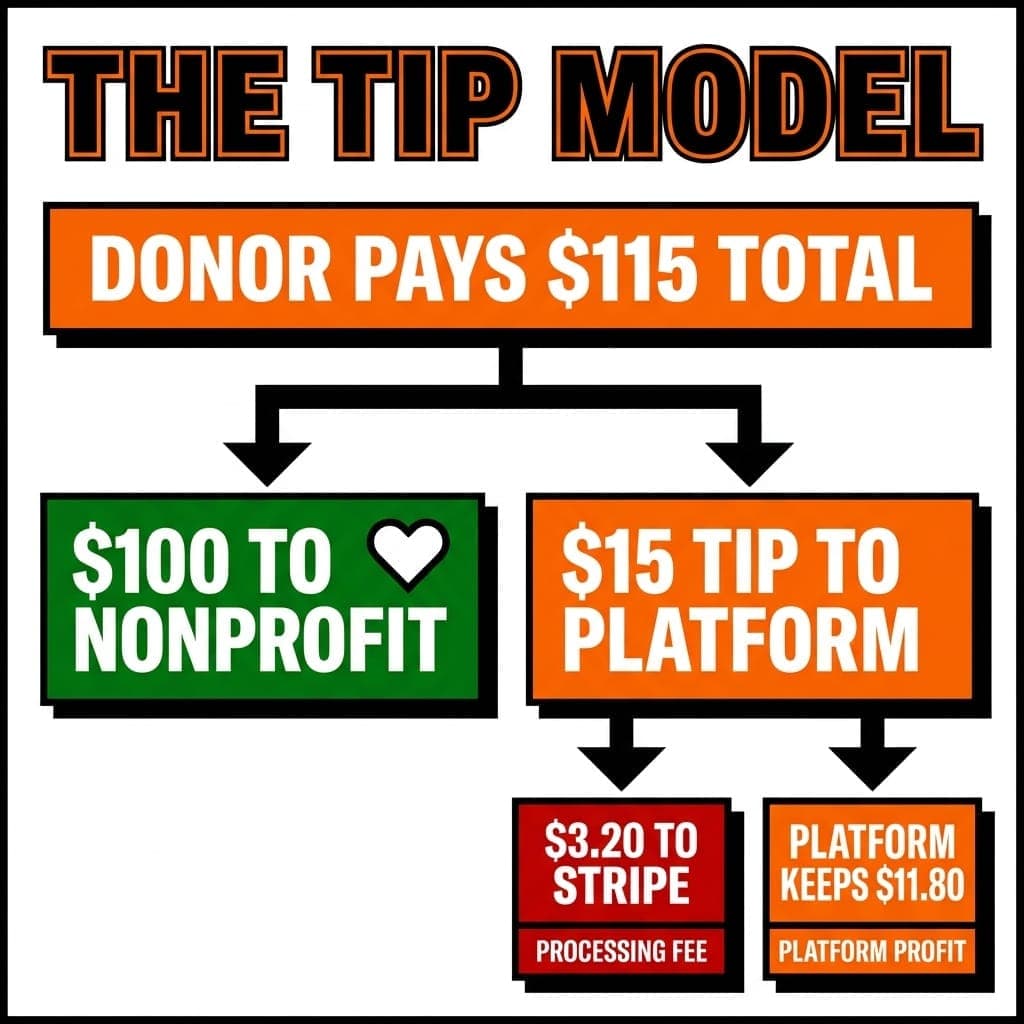
Scenario 1: Tips Enabled
- Donor sees: "Add $15 tip to support this platform?"
- Donor actually pays: $115 (including $15 tip)
- Nonprofit receives: $100
- Stripe processing fee: $3.20 (paid from the tip)
- Platform nets: $11.80 (tip minus processing fee they pay to Stripe)
The "Free Platform Guarantee": These platforms claim they cover processing fees if donors don't tip. But here's the reality: donors are asked to tip first, and over 95% say yes.
Here's the math: One tipping donor generates $11.80 profit for the platform. That $11.80 can cover the processing fees ($3.20 each) for 3-4 non-tipping donors. With a 95% tip rate, the platform is taking a massive cut that a non-profit will never see, even with their "guarantee." They're not being generous—they're running a highly lucrative business model.
And on top of it all, since approximately 70% of nonprofit donors are also volunteers for that organization, you're effectively asking your volunteers to subsidize the platform on top of their time and intended donation.
Scenario 2: Tips Disabled (Event Page)
- Donor pays: $100
- Platform fee (5%): $5
- Processing fee (2.9% + $0.30): $3.20
- Nonprofit receives: $91.80
Why This Should Concern You:
- Donor Confusion: Donors think they're giving $100 to your cause, but they're actually being asked to pay platform fees on top of their intended donation
- Tip Fatigue: Over 95% of donors currently cover fees, but as "tip creep" becomes more prevalent across all industries, this rate will decline
- Psychological Manipulation: The platform profits by making donors feel guilty if they don't tip—creating a negative donation experience
3. The Intermediary Model: When Platforms Hold Your Funds
[!CAUTION] CASE STUDY (December 2025): A major fundraising platform filed for Chapter 11 bankruptcy on December 19, 2025, owing over $29 million to more than 3,200 nonprofits. The company is facing class-action lawsuits and a California Attorney General cease and desist order for allegedly withholding donations. Despite owing tens of millions, the company had only $70,000 in its bank account at filing. Executives allegedly withdrew $3.8 million between December 2024 and December 2025.
Some platforms use an "equity-based" pricing model that sounds fair but compounds costs quickly. However, recent bankruptcies reveal the catastrophic risk of ALL platforms that hold nonprofit funds.
How It Works:
- Monthly Platform Fee: Based on your total annual revenue
- $0-$50K revenue: $125/month
- $50K-$290K revenue: $175/month
- $290K-$1M revenue: $290/month
- Transaction Fee: 6.9% + $0.30 on every donation
- Donor Coverage Option: Donors can choose to cover fees (85% reportedly do)
- "Guaranteed Rate": Some platforms promise you won't pay more than 1.5% per quarter (they credit back the difference)
The Real Cost: Let's say your nonprofit raises $100K annually:
- Monthly fees: $125 × 12 = $1,500/year
- Transaction fees (if donors don't cover): $100K × 6.9% = $6,900/year
- Total platform cost: Up to $8,400/year (8.4% of all funds raised)
Even with the "guaranteed rate" credit and donor coverage, you're paying $1,500 minimum just to have access to the platform.
Why This Should Concern You:
- Catastrophic Platform Risk: Recent bankruptcies prove that platforms holding your funds can—and do—fail, leaving nonprofits with millions in missing donations
- "We Promise Not to Steal" Isn't Enough: Every nonprofit trusted these promises. The model itself creates opportunity for abuse, regardless of intentions
- Double-Dipping: You're paying both monthly fees AND transaction fees
- Revenue-Based Pricing Punishes Growth: The more successful you are, the more you pay
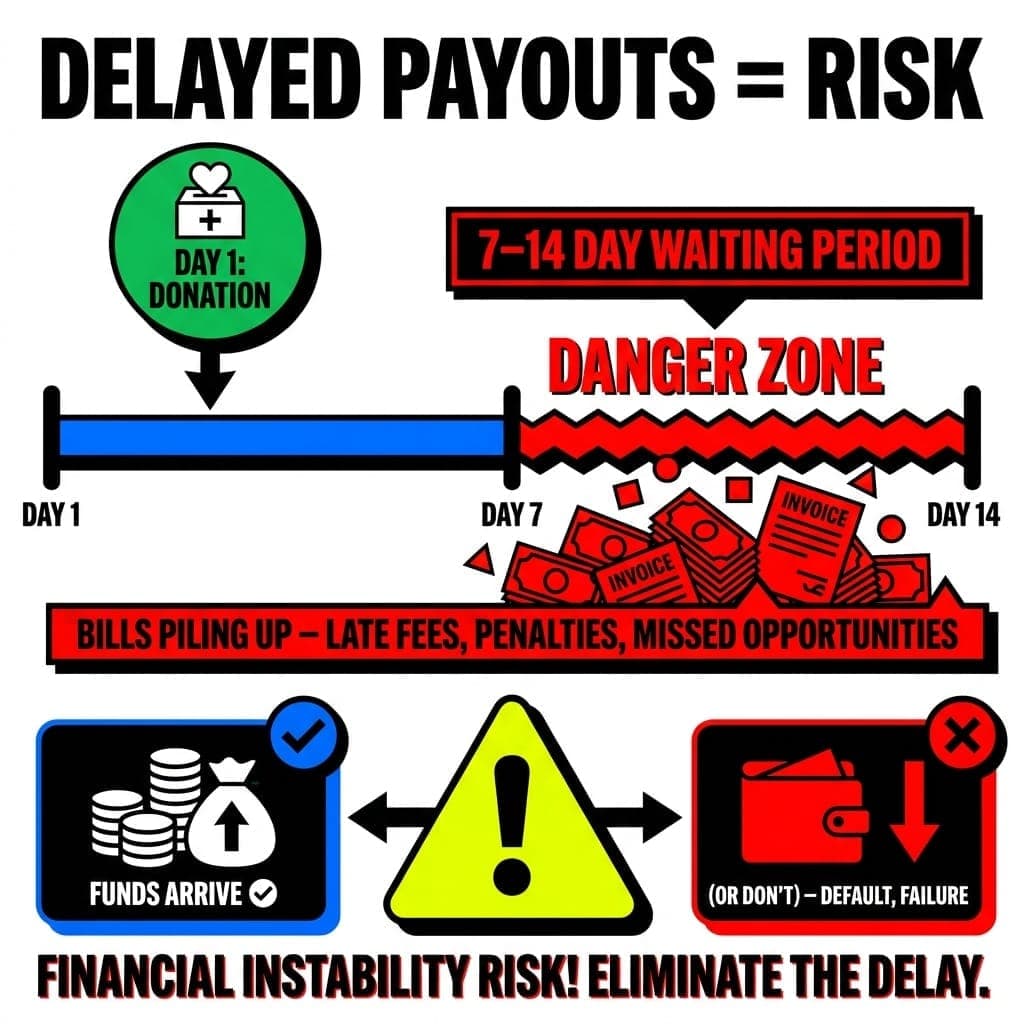
- Cash Flow Delays: Platforms hold funds for 7-14 days before payout—or indefinitely if they face financial trouble
- Locked-In Costs: Even if you have a slow fundraising month, you still owe $125+
The Critical Lesson: When a platform becomes the "merchant of record" and holds your donations, you're not just paying fees—you're taking on existential risk. Nonprofits have lost millions because they trusted platforms to hold their funds. This isn't a company-specific problem; it's a model problem.
The Hidden Danger: You Don't Control the Money
Here's the scariest part that all three platforms share:
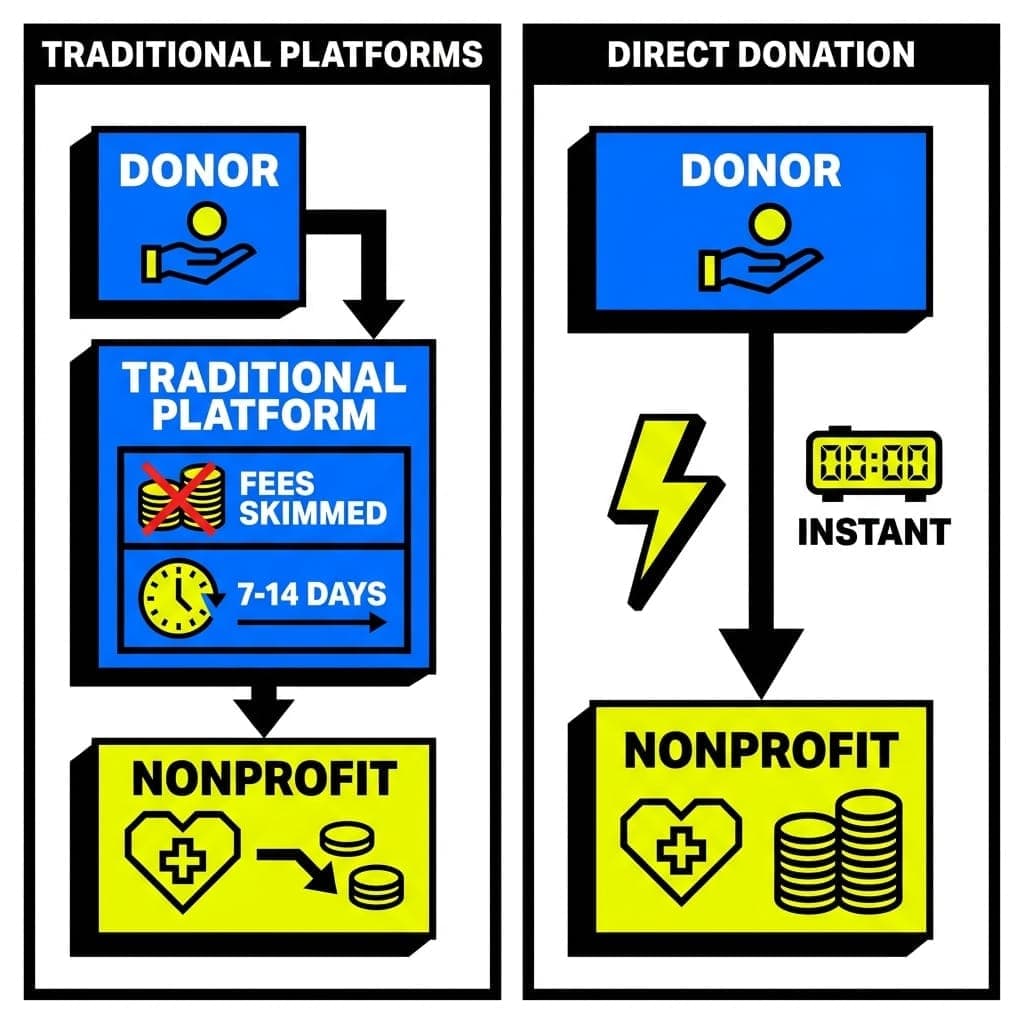
Donations don't go directly to your nonprofit.
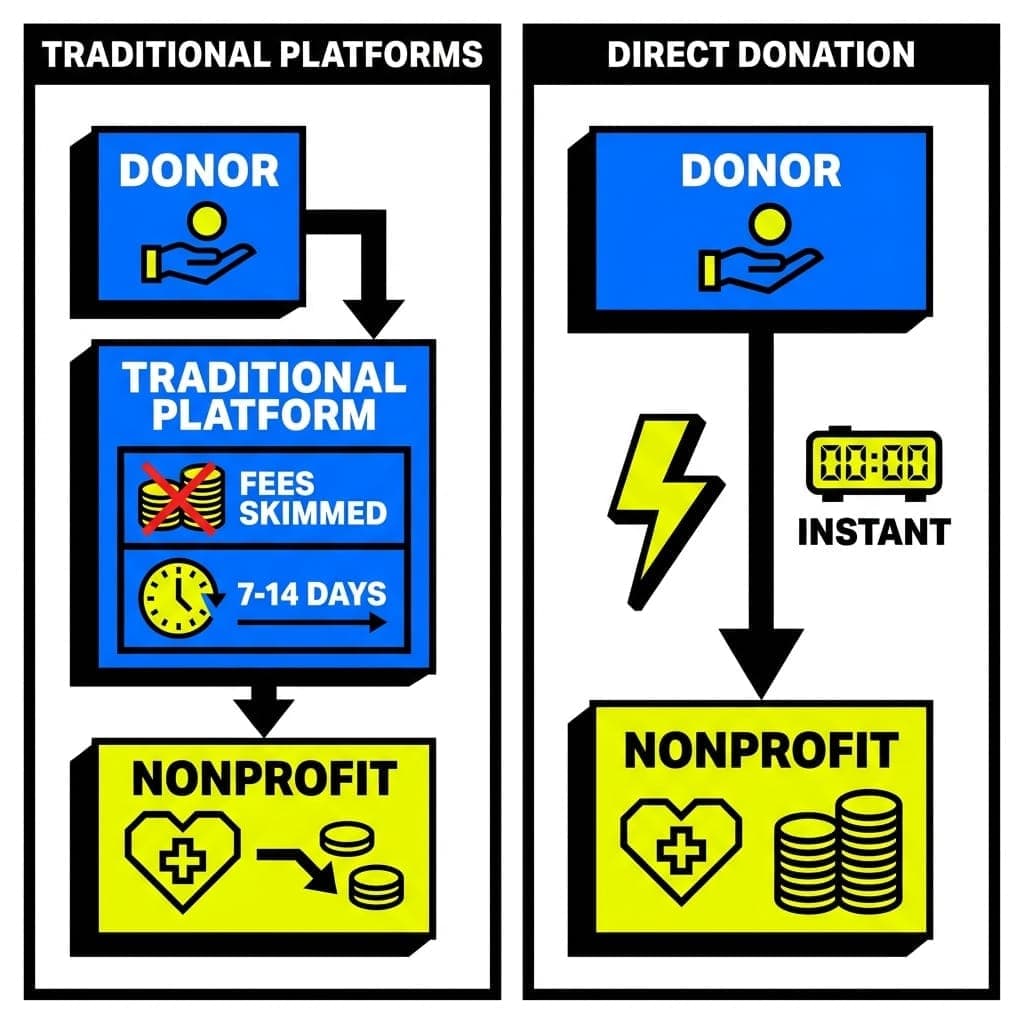
When someone donates through an intermediary platform:
- Funds go to the platform first (they become the "merchant of record")
- Platform holds funds for 7-14 days (sometimes longer)
- Platform deducts fees (tips, platform fees, processing fees)
- Platform transfers remaining funds to your bank
Why This Matters:
- Cash Flow Crisis: You can't access funds immediately for urgent needs
- Platform Risk: If the platform has financial issues, your funds are at risk
- Lack of Control: The platform decides when you get paid
- Donor Relationship: The platform owns the transaction data and donor relationship
- Tax Complications: Some platforms issue tax receipts on your behalf, creating compliance concerns
The Proximatic Difference: Direct Donations, Zero Platform Fees
We built Proximatic specifically to solve these problems.
How Proximatic Works:
- Direct Stripe Connection: Your nonprofit connects your own Stripe account
- Instant Deposits: Donations go directly to your bank (Stripe's standard 2-day processing)
- Zero Platform Fees: We charge $0 in platform fees, tips, or transaction percentages
- You Control Everything: Your Stripe account, your data, your donor relationships, we connect the dots
- Transparent Pricing: Flat event fee based on features you need to run a fundraising event, not revenue you raise.
The Real Numbers:
Important context: Proximatic charges a flat $29 per fundraising event, not per donation. So if your event has 100 donations, that's $0.25 per donation. For complete transparency, we'll show the full $29 cost in this single-donation example. And if your event only does have a singular, $100 donor... oh my.
$100 Donation on Proximatic:
- You pay: $29 event fee (one-time per event, not per donation)
- Donor pays: $100
- Stripe processing fee (standard): $2.90 + $0.30 = $3.20
- Your nonprofit receives: $71.80 (if this were your only donation)
- Proximatic platform fee: $0 per donation
- Reality check: With 100 donations at your event, that $29 fee = $0.25/donation, so you'd actually net $96.55 per $100 donation. Bah. I know. Math... right?
$100 Donation on Tip-Based Platform:
- Donor pays: $115 (including $15 tip)
- Stripe processing fee (standard): $3.20 (paid from the tip)
- Platform keeps: $11.80 (tip minus processing fee)
- Your nonprofit receives: $100.00
- Donor paid 15% more than intended, platform nets $11.80 per $100 donation
$100 Donation on Subscription + Fee Platform:
- Donor pays: $100
- Transaction fee: $6.90 + $0.30 = $7.20
- Monthly platform fee: $125 ÷ monthly donations
- Your nonprofit receives: ~$92.80 (before monthly fee allocation)
- Risk: Funds may never arrive if platform fails
What This Means for Your Mission
Boy that kinda looks bad. But it's not. Let's take a look at some larger numbers.
Let's start with reality: Donors give your nonprofit $50,000 through your fundraising events.
Here's what you actually receive after each platform takes their cut:
| Platform | Donors Give | Event/Subscription Fees | Processing Fees (Stripe) | Platform Profit | Total Fees Taken | You Actually Receive |
|---|---|---|---|---|---|---|
| Proximatic | $50,000 | $625 (25 events × $29) | $1,450 | $0 | $2,075 | $47,925 |
| Tip-Based Platform | $56,600 ($50K + $6,600 tips) | $0 | $1,450 | $5,150 (tips minus processing) | $6,600 extracted from donors | $50,000 |
| Subscription + Fee Platform | $50,000 | $1,500 | $1,600 | $1,600 | $4,700 | $45,300 |
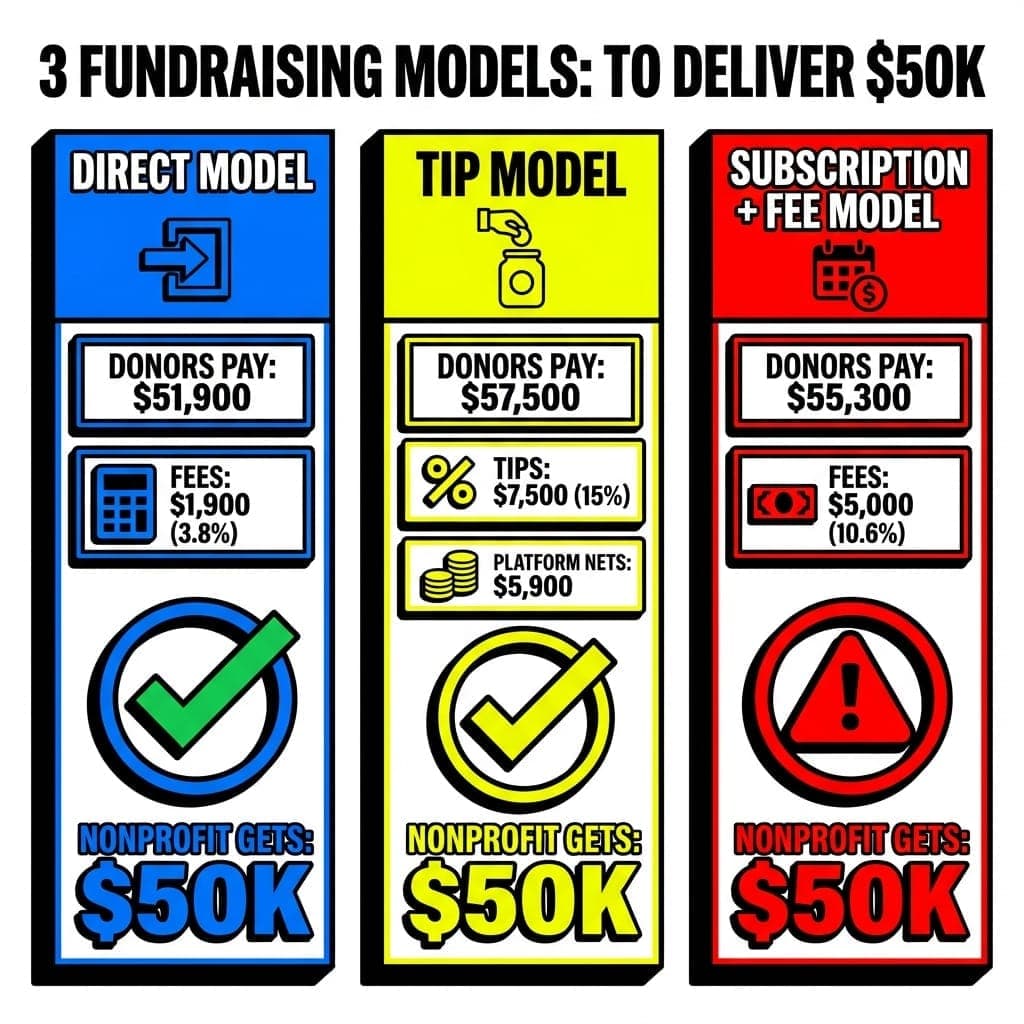
Here's what this actually means:
Proximatic
- Donors give: $50,000
- Your event fees: $625 (25 events × $29) - assuming you raise $2,000 per event
- Stripe processing fees: $1,450 (2.9% of $50K)
- You actually receive: $47,925
- Cost to your mission: $2,075 (4.2%)
Tip-Based Platform
- Donors intend to give: $50,000
- But they're asked: "Add a tip?" (donors add $6,600 in tips)
- Donors actually pay: $56,600 (13.2% more than they intended)
- Stripe processing fees: $1,450 (paid from the tips)
- Platform nets: $5,150 (tips minus processing fees)
- You receive: $50,000
- Cost to your donors: $6,600 (13.2% markup)
Translation: Your donors (mostly volunteers) paid an extra $6,600 in guilt-based tips. The platform pocketed $5,150 profit.
Subscription + Fee Platform
- Donors give: $50,000
- Platform takes: $1,500 subscription + $3,200 in transaction fees = $4,700
- You receive: $45,300 (if funds arrive at all)
- Cost to your mission: $4,700 (9.4%)
The bottom line:
Starting with $50,000 in donations:
- Direct Model (Proximatic): You receive $47,925 (4.2% overhead). Transparent, predictable costs.
- Tip-Based Model: You receive $50,000, but donors paid $56,600 (13.2% markup). Platform profits $5,150 through psychological manipulation.
- Subscription + Fee Model: You receive $45,300 (9.4% overhead), plus existential risk of platform failure.
The Questions You Should Ask Any Platform
Before you commit to a fundraising platform, ask:
- Where do donations go first? (Directly to you, or to the platform?)
- When can I access the funds? (Immediately, or after a holding period?)
- What are ALL the fees? (Platform fees, transaction fees, monthly fees, tips?)
- Who owns the donor data? (You, or the platform?)
- What happens if I want to leave? (Can you export everything? Is there a cancellation fee?)
- Are donors being asked to pay extra? (Tips, fee coverage, etc.)
Why Transparency Matters
We're not saying these platforms are "bad." Many have helped thousands of nonprofits raise money.
But we are saying that nonprofits deserve to know exactly how these platforms make money—and how much of your donors' generosity is being redirected away from your mission.
At Proximatic, we believe:
- Donors should give what they intend to give (no surprise tips or fee coverage requests)
- Nonprofits should receive funds directly (no intermediary holding your money)
- Pricing should be transparent and predictable (not based on how much you raise)
- You should own your donor relationships (not rent them from a platform)
The Bottom Line
The fundraising platform you choose isn't just a technical decision—it's a financial and ethical one.
Choose a platform that:
- ✅ Sends donations directly to your organization
- ✅ Charges transparent, predictable fees
- ✅ Doesn't manipulate donors with "tip" requests
- ✅ Gives you full control of your data and funds
- ✅ Aligns with your mission, not just their profit model
Your donors trust you to steward their gifts wisely. Make sure your platform does the same.
Ready to switch to a platform that puts your mission first? Learn more about Proximatic's direct donation model or get started today.